The emergence of a devastating transmissible facial cancer among Tasmanian devils over the past few decades has caused substantial concern for their future because these animals are already threatened by a regional distribution and other stressors. Little is known about the overall history and trajectory of this disease. Patton et al. used an epidemiological phylodynamic approach to reveal the pattern of disease emergence and spread. They found that low Tasmanian devil densities appear to be contributing to slower disease growth and spread, which is good news for Tasmanian devil persistence and suggests that care should be taken when considering options for increasing devil populations.
Emerging infectious diseases pose one of the greatest threats to human health and biodiversity. Phylodynamics is an effective tool for inferring epidemiological parameters to guide intervention strategies, particularly for human viruses such as severe acute respiratory syndrome coronavirus 2 (SARS-CoV-2). However, phylodynamic analysis has historically been limited to the study of rapidly evolving viruses and, in rare cases, bacteria. Nonetheless, application of phylodynamics to nonviral pathogens has immense potential, such as for predicting disease spread and informing the management of wildlife diseases.
We conducted a phylodynamics analysis of devil facial tumor disease (DFTD), a transmissible cancer that has spread across nearly the entire geographic range of Tasmanian devils and threatens the species with extinction. DFTD is transmitted as an allograft through biting during common social interactions, susceptibility is nearly universal, and case fatality rates approach 100%. The goals of our study were to (i) characterize the geographic spread of DFTD, (ii) identify whether there are different circulating tumor lineages, and (iii) quantify rates of transmission among lineages.
In principle, phylodynamics should be readily extended to the study of slowly evolving pathogens with large genomes through careful interrogation of genes to identify those that are measurably evolving. By testing individual genes for a clocklike signal, these genes may then be used for phylodynamic analysis. We demonstrate this proof of concept in DFTD.
We screened >11,000 genes across the DFTD genome, identifying 28 that exhibited a strong, clocklike signal, and performed the first phylodynamic analysis of a genome larger than a bacterium. We demonstrate here, contrary to field observations, that DFTD spread omnidirectionally throughout the epizootic, leaving little signal of geographic structuring of tumor lineages across Tasmania. Despite predictions of devil extinction, we found that the effective reproduction number (RE), a summary of the rate at which disease spreads, has declined precipitously after the initial epidemic spread of DFTD. Specifically, RE peaked at a high of ~3.5 shortly after the discovery of DFTD in 1996 and is now ~1 in both extant tumor lineages. This is consistent with a shift from emergence to endemism. Except for a single gene, we found little evidence for convergent molecular evolution among tumor lineages.
We addressed two major gaps in the study of antigenic peptides in cancer—namely, the cancer restriction and immunogenicity of noncanonical peptides. These results demonstrate that aberrant translation in pancreatic cancer can give rise to cryptic antigens capable of recognition by T cells. Our data support that a subset of cryptic peptides are cancer restricted, immunogenic, and directly targetable on the surface of human pancreatic cancer cells, nominating them as potential therapeutic targets that warrant further investigation.
We have demonstrated that phylodynamics can be applied to virtually any pathogen. In doing so, we show that through careful interrogation of the pathogen genome, a measurably evolving set of genes can be identified to characterize epidemiological dynamics of nonviral pathogens with large genomes. By applying this approach to DFTD, we have shown that the disease appears to be transitioning from emergence to endemism. Consistent with recent models, our inference that RE ~1 predicts that coexistence between devils and DFTD is a more likely outcome than devil extinction. Therefore, our findings present cautious optimism for the continued survival of the iconic Tasmanian devil but emphasize the need for evolutionarily informed conservation management to ensure their persistence.
过去几十年来,在袋獾中出现的一种毁灭性传染性面部癌症引起了对其未来的极大担忧,因为这些动物已经受到区域分布和其他压力因素的威胁。关于这种疾病的整体历史和轨迹知之甚少。Patton等人采用流行病学系统动力学方法揭示了疾病出现和传播的模式。他们发现,袋獾的低密度似乎有助于减缓疾病的增长和传播,这对于袋獾的持续存在是个好消息,并表明在考虑增加恶魔种群数量的选项时应谨慎行事。
新发传染病是对人类健康和生物多样性的最大威胁之一。系统动力学是推断流行病学参数以指导干预策略的有效工具,特别是对于人类病毒,如严重急性呼吸综合征冠状病毒2(SARS-CoV-2)。然而,系统动力学分析历来局限于研究快速进化的病毒,在少数情况下也用于细菌。尽管如此,将系统动力学应用于非病毒病原体具有巨大潜力,例如预测疾病传播和为野生动物疾病管理提供信息。
我们对恶魔面部肿瘤病(DFTD)进行了系统动力学分析,这是一种传染性癌症,已蔓延到袋獾的几乎整个地理范围,并威胁到该物种的灭绝。DFTD通过常见社会互动中的咬伤作为同种异体移植物传播,易感性几乎普遍,病死率接近100%。我们研究的目标是:(i)描述DFTD的地理传播特征,(ii)确定是否存在不同的循环肿瘤谱系,以及(iii)量化谱系间的传播率。
原则上,通过仔细审查基因以识别那些可测量进化的基因,系统动力学应易于扩展到研究具有大基因组的缓慢进化病原体。通过测试单个基因是否存在类似时钟的信号,这些基因随后可用于系统动力学分析。我们在DFTD中展示了这一概念验证。
我们筛选了DFTD基因组中超过11,000个基因,确定了28个表现出强烈时钟样信号的基因,并进行了首次针对大于细菌基因组的系统动力学分析。我们在此证明,与实地观察相反,DFTD在整个动物流行病期间向各个方向传播,在塔斯马尼亚几乎没有留下肿瘤谱系地理结构的信号。尽管预测恶魔会灭绝,但我们发现有效再生数(RE),即疾病传播率的总结,在DFTD最初流行传播后急剧下降。具体来说,RE在1996年发现DFTD后不久达到约3.5的高峰,现在在两个现存肿瘤谱系中约为1。这与从暴发到地方性流行的转变一致。除了单个基因外,我们发现肿瘤谱系之间几乎没有趋同分子进化的证据。
我们解决了癌症中抗原肽研究的两个主要空白——即非典型肽的癌症限制性和免疫原性。这些结果表明,胰腺癌中的异常翻译可以产生能够被T细胞识别的隐性抗原。我们的数据支持一部分隐性肽具有癌症限制性、免疫原性,并且可以直接靶向人类胰腺癌细胞表面,将它们列为值得进一步研究的潜在治疗靶点。
我们已经证明系统动力学可以应用于几乎任何病原体。通过这样做,我们表明,通过仔细审查病原体基因组,可以识别出一组可测量进化的基因,以描述具有大基因组的非病毒病原体的流行病学动态。通过将这种方法应用于DFTD,我们表明该疾病似乎正在从暴发过渡到地方性流行。与最近的模型一致,我们推断RE ≈ 1预测袋獾与DFTD共存比袋獾灭绝更可能的结果。因此,我们的研究结果为标志性的袋獾的持续生存带来了谨慎的乐观,但强调需要基于进化信息的保护管理以确保它们的持续存在。
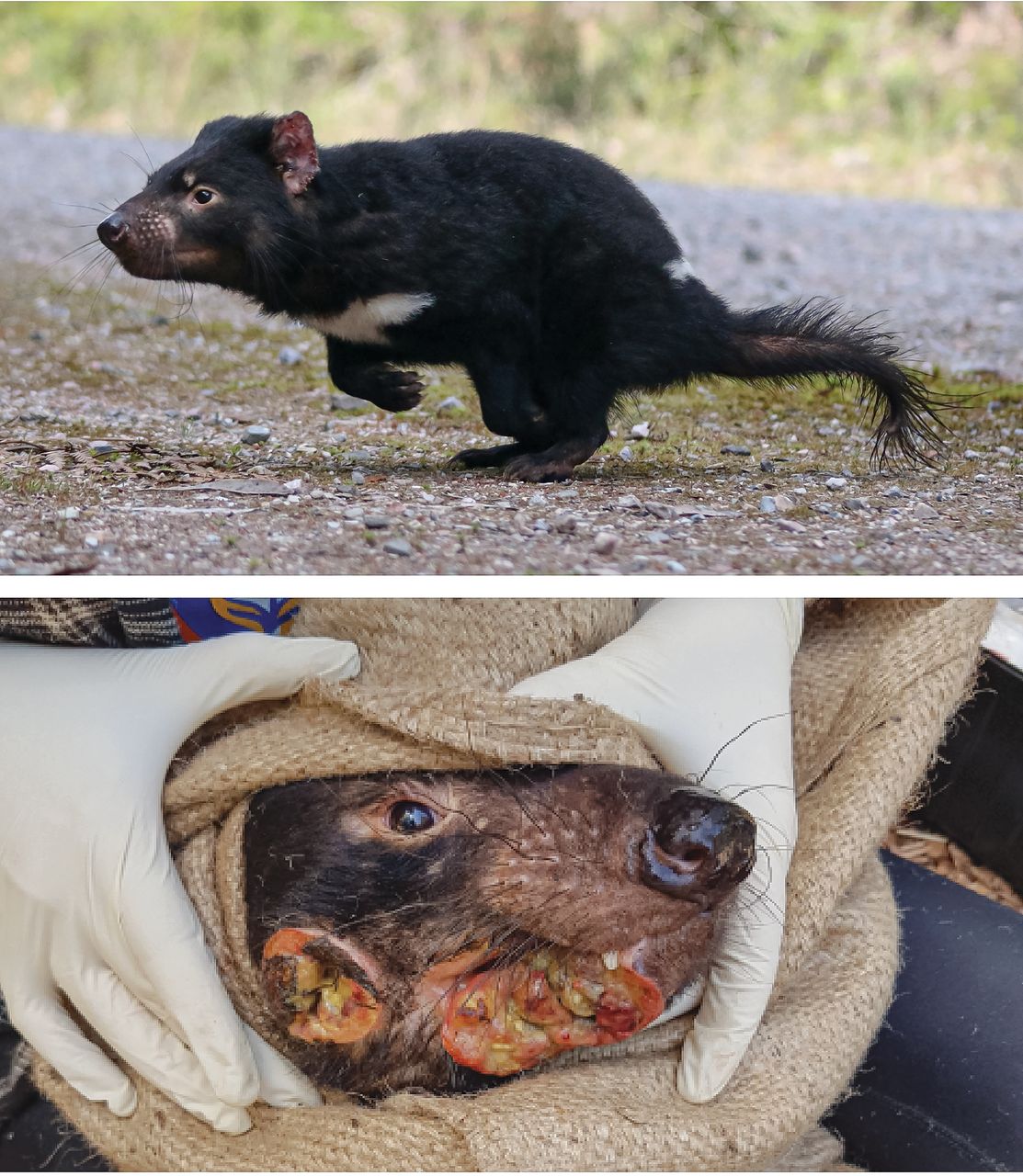
图:袋獾及其传播性癌症。健康的(上图)和感染DFTD的(下图)塔斯马尼亚恶魔。
A transmissible cancer shifts from emergence to endemism in Tasmanian devils
 肿瘤(癌症)患者之家