The biological and physical properties of tumors contribute to their growth and to treatment outcome. Although intense research efforts have helped to delineate cancer biology, the physics of cancer has only emerged in relatively recent times as a key area of research. Nia et al. reviewed the physical features that are common to tumors and that limit successful treatment: solid stresses, interstitial fluid pressure, stiffness (rigidity), and architecture and organization of tumor constituents. The authors provide a conceptual framework and discuss the origins of these distinct physical traits of cancer and how they enable and synergize with aberrant cancer biology to fuel cancer initiation, progression, immune evasion, and treatment resistance.
Historically, cancer has been considered a disease of the cell, caused by mutations in genes that control proliferation, differentiation, and death. In recent decades, however, the microenvironment surrounding the cancer cell has gained notoriety as a coconspirator in tumor initiation, progression, immune evasion, and treatment response. As tumors grow, they disrupt the structure and function of the surrounding tissue via physical and biochemical mechanisms. The resulting physical abnormalities affect both cancer cells and their microenvironment and fuel tumorigenesis and treatment resistance. The links between cancer biology and physics have provided opportunities for the discovery of new drugs and treatment strategies.
Here, we propose four distinct physical cancer traits that capture the biomechanical abnormalities in tumors: (i) elevated solid stress, (ii) elevated interstitial fluid pressure, (iii) increased stiffness and altered material properties, and (iv) altered tissue microarchitecture. Solid stresses are created as proliferating and migrating cells push and stretch solid components of the surrounding tissue. Being distinct from fluid pressure and close to zero in most normal tissues, solid stresses are large enough to compress blood and lymphatic vessels in and around tumors, impairing blood flow and the delivery of oxygen, drugs, and immune cells. Acting at organ, tissue, and cellular levels, solid stresses activate signaling pathways that promote tumorigenesis and invasiveness and induce treatment resistance. Elevated interstitial fluid pressure is caused by leakage of plasma from abnormally permeable tumor blood vessels and insufficient lymphatic drainage. As a result, the interstitial fluid leaks out of the tumor into the peritumor tissue, causing edema and elution of drugs and growth factors and facilitating invasion and metastasis through flow-induced shear stresses. Increased stiffness is caused by matrix deposition and remodeling. Traditionally used as a diagnostic marker, and more recently as a prognostic factor, increased stiffness activates signaling pathways that promote proliferation, invasiveness, and metastasis of cancer cells. Finally, when normal tissue architecture is disrupted by cancer growth and invasion, microarchitecture is altered. Stromal and cancer cells and extracellular matrix adopt new organization. This changes the interactions between an individual cell and its surrounding matrix and cells, which affects signaling pathways associated with invasion and metastasis.
The tumor microenvironment is characterized by both biological and physical abnormalities. The growing appreciation of the role of tumor-stromal interactions in cancer has led to seminal discoveries that have resulted in previously unexplored targets and strategies for treatment. Understanding the key principles underlying the origins and consequences of the physical traits of cancer will be critical for improving treatment. Many of the concepts involved are nonintuitive and require deep and broad understanding of both the physical and biological aspects of cancer. Therefore, a rigorous but accessible description of physical cancer traits will assist research into the physical sciences of cancer—a highly multidisciplinary area—and help it remain an active and progressive subfield of cancer research.
The role of the physical microenvironment in tumor development, progression, metastasis, and treatment is gaining appreciation. The emerging multidisciplinary field of the physical sciences of cancer is now embraced by engineers, physicists, cell biologists, developmental biologists, tumor biologists, and oncologists attempting to understand how physical parameters and processes affect cancer progression and treatment. Discoveries in this field are starting to be translated into new therapeutic strategies for cancer. In this Review, we propose four physical traits of tumors that contribute to tumor progression and treatment resistance: (i) elevated solid stresses (compression and tension), (ii) elevated interstitial fluid pressure, (iii) altered material properties (for example, increased tissue stiffness, which historically has been used to detect cancer by palpation), and (iv) altered physical microarchitecture. After defining these physical traits, we discuss their causes, consequences, and how they complement the biological hallmarks of cancer.
肿瘤的生物学和物理特性影响其生长和治疗效果。尽管大量研究已帮助阐明癌症生物学,但癌症物理学仅在相对近期才成为关键研究领域。Nia等人综述了肿瘤共有的物理特征,这些特征限制了成功治疗:固体应力、间质液压力、刚度(刚性)以及肿瘤成分的结构和排列。作者提供了一个概念框架,并讨论了这些独特癌症物理特征的起源,以及它们如何与异常癌症生物学协同作用,促进癌症的发生、进展、免疫逃逸和治疗抵抗。
历史上,癌症被视为一种细胞疾病,由控制增殖、分化和死亡的基因突变引起。然而,近几十年来,癌细胞周围的微环境作为肿瘤发生、进展、免疫逃逸和治疗反应的共谋者而备受关注。随着肿瘤生长,它们通过物理和生化机制破坏周围组织的结构和功能。由此产生的物理异常影响癌细胞及其微环境,并促进肿瘤发生和治疗抵抗。癌症生物学与物理学之间的联系为新药和治疗策略的发现提供了机会。
在此,我们提出四种独特的癌症物理特征,它们概括了肿瘤中的生物力学异常:(i) 升高的固体应力,(ii) 升高的间质液压力,(iii) 增加的刚度和改变的材料性质,以及 (iv) 改变的组织微结构。固体应力由增殖和迁移的细胞推拉周围组织的固体成分产生。与液体压力不同,在大多数正常组织中接近于零,固体应力足够大,可以压迫肿瘤内外的血管和淋巴管,损害血流以及氧气、药物和免疫细胞的输送。在器官、组织和细胞水平上作用,固体应力激活促进肿瘤发生和侵袭性以及诱导治疗抵抗的信号通路。升高的间质液压力是由肿瘤血管通透性异常导致血浆泄漏和淋巴引流不足引起的。结果,间质液从肿瘤泄漏到肿瘤周围组织,引起水肿和药物及生长因子的洗脱,并通过流动诱导的剪切应力促进侵袭和转移。增加的刚度由基质沉积和重塑引起。传统上用作诊断标志物,最近作为预后因素,增加的刚度激活促进癌细胞增殖、侵袭性和转移的信号通路。最后,当正常组织结构被癌症生长和侵袭破坏时,微结构发生改变。基质细胞、癌细胞和细胞外基质采用新的排列。这改变了个体细胞与其周围基质和细胞之间的相互作用,从而影响与侵袭和转移相关的信号通路。
肿瘤微环境以生物和物理异常为特征。对肿瘤-基质相互作用在癌症中作用的日益认识带来了开创性发现,从而产生了以前未探索的治疗靶点和策略。理解癌症物理特征起源和后果的关键原理对于改进治疗至关重要。涉及的许多概念不直观,需要对癌症的物理和生物学方面有深入而广泛的理解。因此,对癌症物理特征进行严谨但易于理解的描述将有助于癌症物理科学——一个高度多学科领域——的研究,并帮助它保持作为癌症研究中活跃和进展中的子领域。
物理微环境在肿瘤发展、进展、转移和治疗中的作用日益受到重视。新兴的癌症物理科学多学科领域现在受到工程师、物理学家、细胞生物学家、发育生物学家、肿瘤生物学家和肿瘤学家的关注,他们试图理解物理参数和过程如何影响癌症进展和治疗。该领域的发现正开始转化为新的癌症治疗策略。在这篇综述中,我们提出了四种促进肿瘤进展和治疗抵抗的肿瘤物理特征:(i) 升高的固体应力(压缩和张力),(ii) 升高的间质液压力,(iii) 改变的材料性质(例如,增加的组织刚度,历史上通过触诊检测癌症),以及 (iv) 改变的物理微结构。在定义这些物理特征后,我们讨论它们的原因、后果,以及它们如何补充癌症的生物学特征。
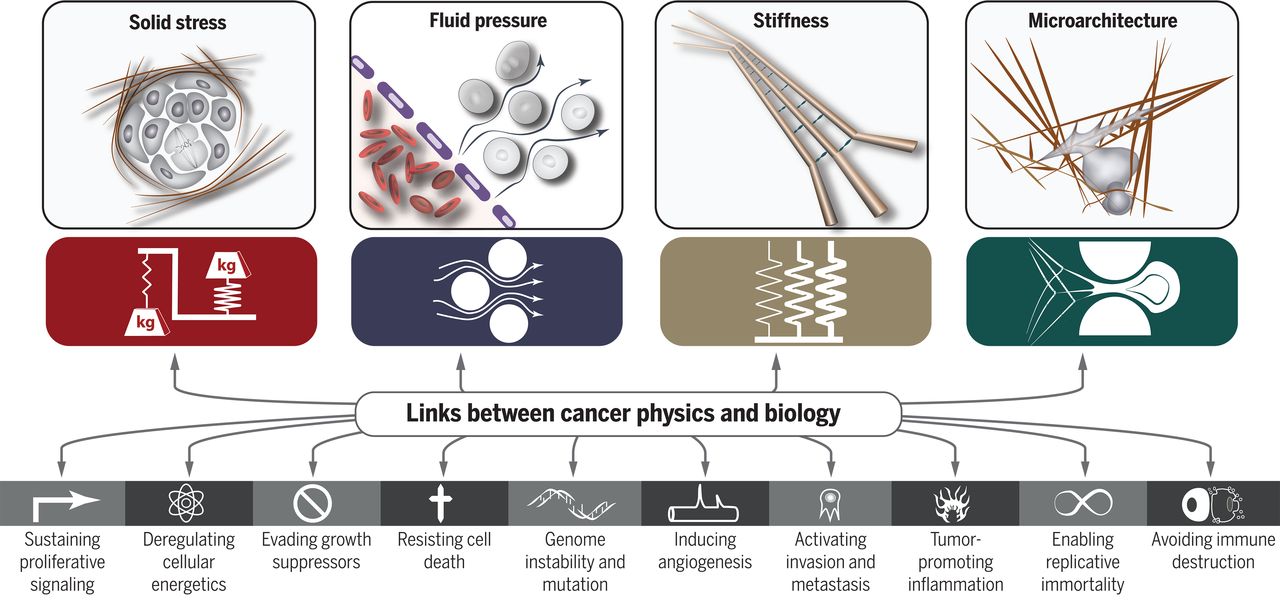
图:癌症的物理特性。为了提供一个综合框架,从少量基本原理的角度理解癌症物理学与癌症生物学中信号通路之间的联系,我们提出了癌症的四个物理特性,这些特性描述了大多数(即使不是全部)肿瘤共有的主要物理异常。
 肿瘤(癌症)患者之家