Many types of cancer are detected at an advanced stage, when treatment options are limited and prognosis is poor. Being able to detect cancers early can substantially improve survival, but this approach comes with challenges, including the possibility of overdiagnosis and overtreatment, which can harm people who would not have developed overt malignancy. In a Review, Crosby et al. discuss the importance of cancer early detection and the main challenges that need to be overcome to better understand the early events in tumorigenesis that are detectable in screening tests. The results of these tests can then be reliably interpreted to determine whether an individual requires treatment. —GKA
When cancer is detected at the earliest stages, treatment is more effective and survival drastically improves. Yet ~50% of cancers are still only detected at an advanced stage. Improved earlier detection of cancer could substantially increase survival rates. Although recent advances in early detection have saved lives, further innovations and development of early cancer detection approaches are needed. The field is evolving rapidly, owing to advances in biological understanding and an increasing pace of technological progress.
We highlight five challenges facing the field, current work in those areas, and where more research is needed to make early detection a reality. The first challenge is to build a greater understanding of the biology and behavior of early disease. This will help identify ways to distinguish between consequential, aggressive lesions and inconsequential lesions that will not cause harm. Such insight will be crucial to realizing the potential for early detection to inform treatment decisions and improve survival, while minimizing the risk of overtreatment. Alongside studies in human samples, better models of disease are enabling identification of early signals of tumorigenesis and clarifying the contributions of the immune system and microenvironment to tumor development.
The second challenge is determining the risk of developing cancer. How can we use germline genomic susceptibility, family history, exposures, demographic, and behavioral data to build nuanced risk models to identify who should be tested for cancer and how test results should be interpreted and followed up? Progress is being made to address this challenge through improved understanding of the genomics of cancer risk, integration of that insight with other risk factors, and the development of large-scale population cohorts where risk models can be developed and validated.
The third challenge is finding and validating biomarkers of early cancer. There is considerable difficulty in finding accurate signals of early cancer (which usually exist in very small amounts) amid the noise of normal human physiology. Although progress has historically been slow, many promising early detection markers are emerging, including circulating tumor DNA, circulating tumor cells, proteins, exosomes, and cancer metabolites. Advances in data analysis methodologies (such as machine learning) and integration across marker types in multimodal tests are also accelerating progress.
The fourth challenge is technological. It involves both the iterative improvement of existing approaches and the development of disruptive detection technologies that can very sensitively and specifically identify early biological changes, whether in tissue structure, biochemistry, or function. Powerful molecular analytical technologies and advanced imaging and histopathological methods are increasing the ability to sensitively find earlier tumors, while the use of synthetic markers may help to amplify their signal.
The fifth challenge is how to appropriately evaluate early detection approaches. Translation of biological insights into new diagnostic technologies and execution of clinical trials to validate those advances require substantial time and money. We discuss ways in which that process might be improved.
For early detection to deliver transformative progress in cancer survival, wider skill sets beyond cancer biology are essential, including engineers, chemists, physicists, technology developers, and behavioral and computer scientists. Integrated, interdisciplinary collaboration is key to bringing new ideas to address the challenges of early cancer detection. We believe that early detection of cancer is approaching a tipping point, as biological insight and technological capacity are increasing at an unprecedented rate and as public and private funders of research are increasingly willing to invest. This Review discusses the current state of the field and suggests constructive ways forward that build on current progress to deliver effective earlier detection of cancer and appropriate intervention.
Survival improves when cancer is detected early. However, ~50% of cancers are at an advanced stage when diagnosed. Early detection of cancer or precancerous change allows early intervention to try to slow or prevent cancer development and lethality. To achieve early detection of all cancers, numerous challenges must be overcome. It is vital to better understand who is at greatest risk of developing cancer. We also need to elucidate the biology and trajectory of precancer and early cancer to identify consequential disease that requires intervention. Insights must be translated into sensitive and specific early detection technologies and be appropriately evaluated to support practical clinical implementation. Interdisciplinary collaboration is key; advances in technology and biological understanding highlight that it is time to accelerate early detection research and transform cancer survival.
许多癌症在发现时已处于晚期,此时治疗选择有限且预后不良。能够在早期检测出癌症可以显著提高生存率,但这种方法也伴随着挑战,包括过度诊断和过度治疗的可能性,这可能对那些本不会发展为明显恶性肿瘤的人造成伤害。在一篇综述中,Crosby等人讨论了癌症早期检测的重要性,以及为更好地理解可在筛查检测中发现的肿瘤发生早期事件而需要克服的主要挑战。随后可以可靠地解读这些检测结果,以确定个体是否需要治疗。—GKA
当癌症在最早阶段被检测出来时,治疗更有效,生存率也会大幅提高。然而,仍有约50%的癌症仅在晚期才被发现。改进癌症的早期检测可以显著提高生存率。尽管近期在早期检测方面的进展已挽救了生命,但仍需进一步的创新和早期癌症检测方法的开发。由于生物学理解的进步和技术发展步伐的加快,该领域正在迅速发展。
我们重点阐述了该领域面临的五项挑战、当前在这些领域的工作,以及为实现早期检测需要更多研究的方面。第一个挑战是加深对早期疾病生物学和行为学的理解。这将有助于找出区分有临床意义的侵袭性病变和无害的非重要病变的方法。这种洞察力对于实现早期检测为治疗决策提供信息、提高生存率,同时最大限度地降低过度治疗风险的潜力至关重要。除了对人类样本的研究,更好的疾病模型正在帮助识别肿瘤发生的早期信号,并阐明免疫系统和微环境对肿瘤发展的作用。
第二个挑战是确定患癌风险。我们如何利用种系基因组易感性、家族史、暴露史、人口统计学和行为数据来建立细致的风险模型,以确定谁应该接受癌症检测,以及如何解读和跟进检测结果?通过对癌症风险基因组学的更好理解、将这些见解与其他风险因素整合,以及在可开发和验证风险模型的大规模人群队列中进行研究,正在取得应对这一挑战的进展。
第三个挑战是寻找和验证早期癌症的生物标志物。在正常人体生理的"噪音"中寻找早期癌症的准确信号(通常含量极少)存在相当大的困难。尽管历史上的进展缓慢,但许多有希望的早期检测标志物正在涌现,包括循环肿瘤DNA、循环肿瘤细胞、蛋白质、外泌体和癌症代谢物。数据分析方法(如机器学习)的进步以及多模态检测中跨标志物类型的整合也正在加速进展。
第四个挑战是技术性的。它既涉及现有方法的迭代改进,也涉及开发颠覆性的检测技术,这些技术能够非常灵敏和特异地识别早期生物变化,无论是在组织结构、生物化学还是功能方面。强大的分子分析技术以及先进的成像和组织病理学方法正在提高灵敏发现更早期肿瘤的能力,而合成标记物的使用可能有助于放大其信号。
第五个挑战是如何适当评估早期检测方法。将生物学见解转化为新的诊断技术,以及进行临床试验来验证这些进展,需要大量时间和金钱。我们讨论了可能改进这一过程的途径。
为了让早期检测在癌症生存率方面带来变革性进展,除了癌症生物学外,更广泛的技能组合至关重要,包括工程师、化学家、物理学家、技术开发人员以及行为与计算机科学家。综合性的跨学科合作是将新思路应用于应对癌症早期检测挑战的关键。我们相信,癌症早期检测正接近一个临界点,因为生物学洞察力和技术能力正以前所未有的速度增长,并且公共和私人研究资助方越来越愿意投资。本综述讨论了该领域的现状,并提出了基于当前进展的建设性前进道路,以实现有效的癌症早期检测和适当干预。
癌症发现得越早,生存率越高。然而,约50%的癌症在诊断时已处于晚期。癌症或癌前病变的早期检测使得早期干预成为可能,以试图延缓或阻止癌症的发展和致死性。要实现所有癌症的早期检测,必须克服诸多挑战。更好地了解谁面临最大的患癌风险至关重要。我们还需要阐明癌前病变和早期癌症的生物学特征和发展轨迹,以识别需要干预的有临床意义的疾病。这些洞察必须转化为灵敏且特异的早期检测技术,并经过适当评估以支持实际的临床实施。跨学科合作是关键;技术和生物学理解的进步表明,现在是时候加速早期检测研究并改变癌症生存状况了。
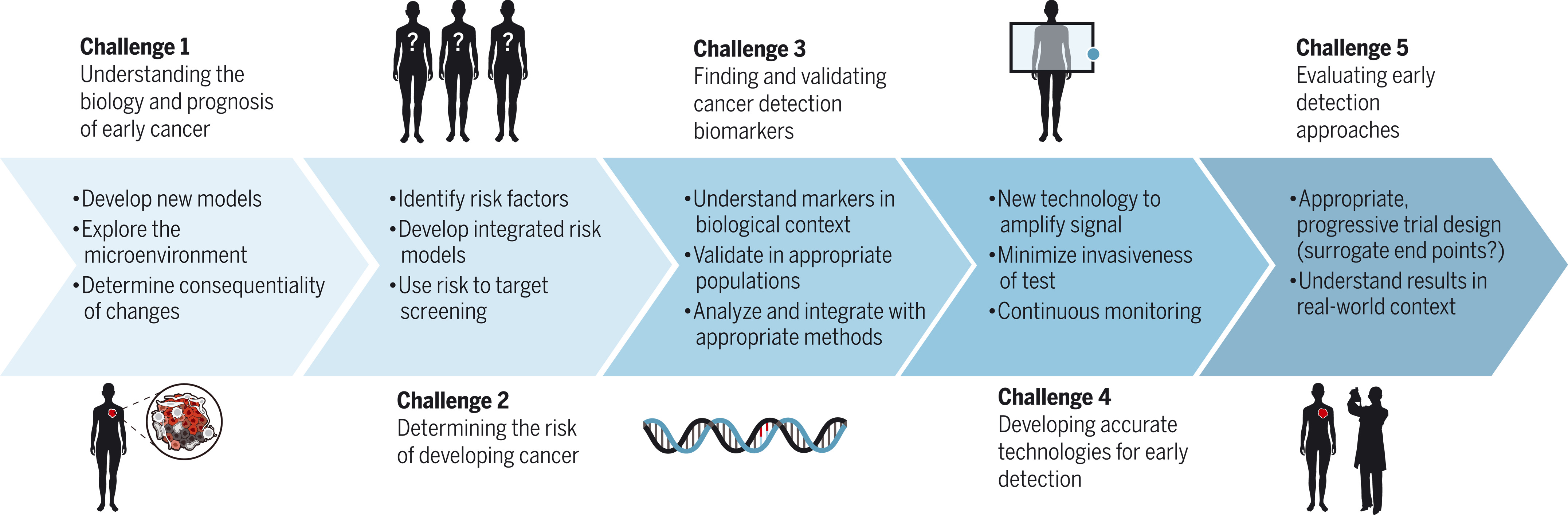
图:癌症早期检测——挑战与前景。此图总结了阻碍癌症早期检测的挑战,以及当前研究助力克服这些挑战的领域。
 肿瘤(癌症)患者之家